

In August 2025, communities across the United States will mark a milestone—the 60th anniversary of the Community Health Center (CHC) movement—during National Health Center Week (NHCW). Scheduled from Aug. 3 to Aug. 9, this annual observance is more than a celebration; it’s a strategic moment to showcase the essential work and enduring legacy of health centers nationwide.
CHCs, from urban neighborhoods to rural regions, have provided vital care since the 1960s. Born out of the Civil Rights Movement and President Lyndon B. Johnson’s War on Poverty, these centers were created to confront the racial and economic injustices that had long shaped health outcomes in the United States. The first CHCs—established in Boston’s Columbia Point housing project and in Mound Bayou, Mississippi—served predominantly Black and low-income populations who had been systematically excluded from care. These early models didn’t just treat illness; they tackled the social conditions driving poor health, with community members helping to govern and shape services. Sixty years later, that mission remains unchanged: CHCs continue to deliver care designed for—and with—the people they serve.
To understand how CHCs continue fulfilling this mission today, it’s important to look at how they are structured and supported. These centers are a category of safety-net providers that deliver comprehensive, culturally responsive care regardless of patients’ ability to pay. Under federal law, there are three recognized models that operate as CHCs: federally qualified health centers (FQHCs), which receive federal grants and enhanced Medicaid and Medicare reimbursement; FQHC Look-Alikes, which meet the same standards but operate without Section 330 grant funding; and certain tribal and urban Indian health organizations, which may qualify for similar benefits through separate federal designations. All three models share the same core requirements, including offering services on a sliding fee scale and being governed by a board that includes patient members.
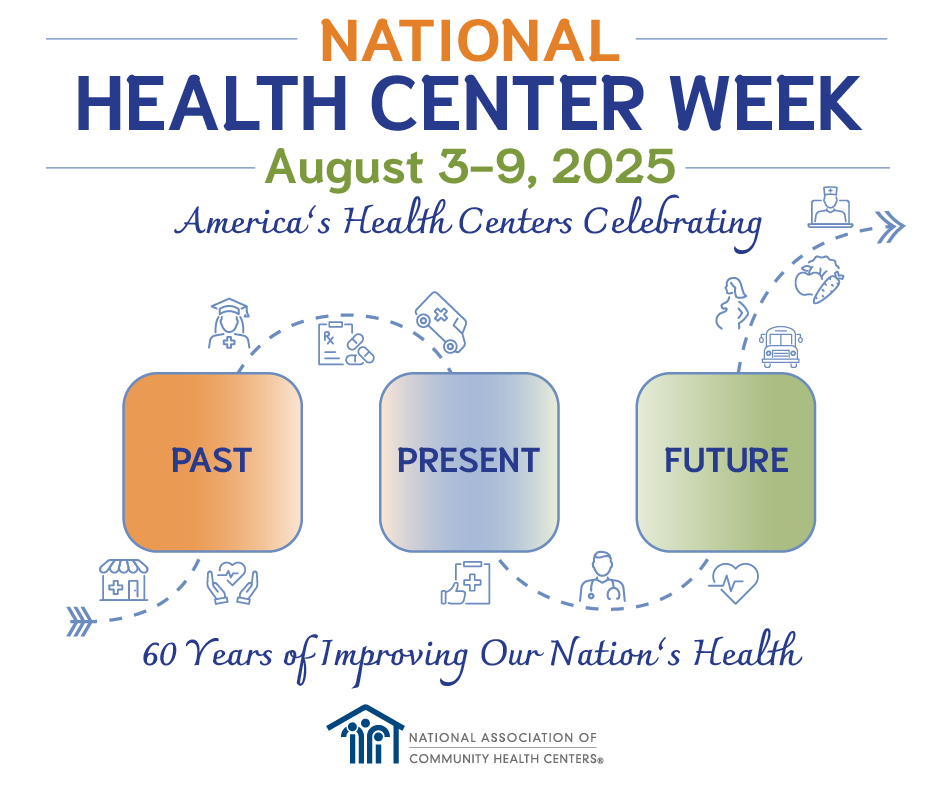
The theme of NHCW 2025, “60 Years Strong: Past, Present, and Future,” emphasizes the resilience, innovation, and dedication embedded within health center models nationwide. (Graphic courtesy of NACHC)
The theme of NHCW 2025, “60 Years Strong: Past, Present, and Future,” emphasizes the resilience, innovation, and dedication embedded within health center models nationwide. According to the National Association of Community Health Centers (NACHC), more than 1,100 events were hosted in 2024 alone, with participation from thousands of community members, health care workers, policymakers, and elected officials across the country.
While the week celebrates accomplishments, it also draws attention to the policy issues that threaten the ability to deliver on their mission. This year’s celebration underscores several vital health center priorities. These include sustainable funding, workforce development, telehealth policies, and protection of the federal 340B drug discount program. All federal funding for CHCs, including key workforce programs such as the National Health Service Corps and Teaching Health Center Graduate Medical Education, is currently set to expire on Sept. 30, 2025. Likewise, pandemic-era Medicare telehealth policies will lapse on the same date unless reauthorized.
These policy considerations underscore the strategic importance of NHCW—not just as a celebration, but as a vehicle for advocacy and policy engagement. Throughout the week, community health centers will welcome legislators and local leaders, providing firsthand exposure to the comprehensive services they deliver and reinforcing their significant impact on public health and local economies.
NACHC recommends using this week strategically, urging CHCs to host facility tours, community outreach events, and discussions with elected officials to highlight the critical importance of continued funding and legislative support to their operations. “National Health Center Week is the perfect opportunity to invite lawmakers to your events and show them how you’re transforming lives and strengthening your communities,” said Joe Dunn, NACHC chief policy officer, during the 2025 NHCW Kickoff Webinar.
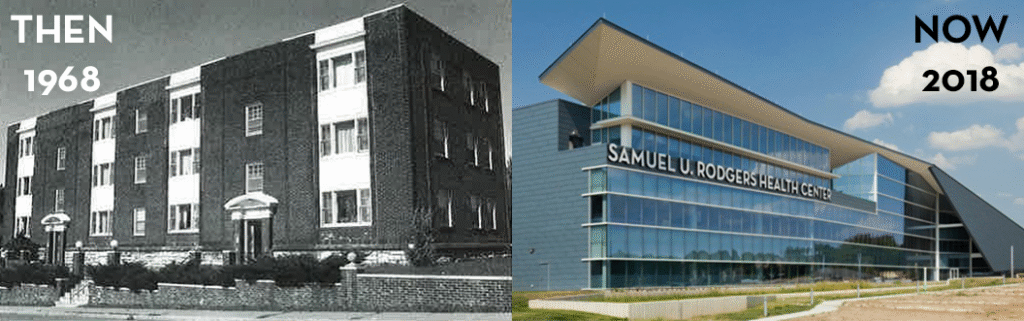
Samuel U. Rodgers Health Center Then v. Now (Courtesy of Samuel U. Rodgers Health Center)
Where a Health Center Becomes a Movement
Health centers across the country will use this opportunity to illustrate their value—none more clearly than those with deep historical roots and measurable impact, like one long-standing Kansas City institution. Samuel U. Rodgers Health Center embodies the enduring commitment and community-centered vision that defined the earliest health center models.
Founded in 1968 by Dr. Samuel U. Rodgers, an obstetrician-gynecologist, the center began as a direct response to the racial and economic segregation that defined Kansas City at the time. Hospitals often turned away Black patients or relegated them to overcrowded wards with limited access to specialists. Many families living in the city’s public housing had no regular access to a physician at all. Dr. Rodgers believed that quality care was not a privilege, but a right—and that care should be rooted in the lived experiences of the people it served.
He opened the clinic in the basement of the Wayne Miner housing project—just east of Troost Avenue, a dividing line that symbolized much of the city’s racial and socioeconomic separation. From the start, he insisted that families help guide how the clinic operated, laying the foundation for a patient-centered model that emphasized trust, dignity, and whole-person care. His work aligned with the national health center movement but reflected something more personal: a refusal to accept the health disparities he saw around him. As his wife, Mamie Hughes Rodgers, later reflected, “He felt strongly about the fact that there could be an entity that would reproduce and care for those who could not care for themselves.”
More than five decades later, Sam Rodgers serves thousands of patients annually, providing comprehensive primary and preventive health care, behavioral health, dental services, and pharmacy support. The center is not merely a health care provider; it is an economic engine, employing hundreds and generating substantial economic output for the Kansas City region.
Like many CHCs nationwide, Sam Rodgers faces ongoing challenges, including rising health care costs, workforce shortages, and funding uncertainties. Despite these pressures, its role remains indispensable. CHCs save taxpayer dollars by reducing emergency room visits, managing chronic diseases proactively, and focusing on preventive care—proven strategies for cost efficiency, and better health outcomes.
As the nation marks 60 years of the health center movement, Sam Rodgers stands as both a reflection of that legacy and a reminder of its original purpose—to close care gaps, challenge injustice, and build healthier futures from the ground up.
An Advocacy Moment
During NHCW, Sam Rodgers, alongside other CHCs across the nation, will amplify advocacy efforts. One primary concern is securing long-term federal funding. More than 70% of federal grant funding for CHCs is due to expire without clear assurances of renewal, creating significant uncertainty around staffing, service delivery, and future planning.
NACHC’s toolkit for engaging elected officials during in-district visits emphasizes the importance of these meetings. Health centers are encouraged to use NHCW to showcase their impact directly to policymakers. By providing real-world stories, CHCs bring abstract policy discussions into sharp focus. For Sam Rodgers, this involves highlighting their innovative programs—such as integrated maternal and infant health services and robust telehealth capabilities—that directly address community needs.
Daily Celebrations and Strategic Actions
Each day of NHCW focuses on specific themes, giving health centers targeted opportunities for outreach:
- Sunday, Aug. 3: Celebrating 60 Years of Progress
- Monday, Aug. 4: Staff Appreciation Day
- Tuesday, Aug. 5: Patient Appreciation Day
- Wednesday, Aug. 6: Health Conditions Day
- Thursday, Aug. 7: Population Focus
- Friday, Aug. 8: Partner Appreciation Day
- Saturday, Aug. 9: Gratitude & Future Vision
Health centers nationwide will host appreciation events, health fairs with free screenings, historical exhibits showcasing their evolution, and community forums highlighting future goals.
As CHCs plan events aligned with each day’s theme, storytelling becomes a central strategy for driving awareness and action.
Engaging Through Advocacy and Storytelling
Angelique Wilkins, chief communications and engagement officer at NACHC, emphasizes the crucial role of storytelling during NHCW. “Advocacy happens every day. We need people to stand up, tell their stories, and educate their communities on the lifesaving work of health centers. This isn’t just about legislative priorities; it’s about building a broader understanding and sustained support for our health centers,” she explained during a recent kickoff webinar.
In Kansas City, Sam Rodgers’ storytelling focuses on the lives changed through high-quality, compassionate, and affordable care. From maternal health success stories supported by innovative doula programs to chronic disease management facilitated by community health workers, these narratives demonstrate the transformative power of community-focused health care.
Beyond 2025: Sustaining a Legacy
NHCW serves not only to honor past accomplishments but also to energize future advocacy. As Kyu Rhee, MD, MPP, president and CEO of NACHC, stated during the kickoff webinar, “Unity is crucial. Health centers are facing financial and staffing challenges nationwide. Our strength comes from speaking with a unified voice about our indispensable role in America’s health care landscape.”
Moving forward, CHCs will continue to advocate for sustainable funding, expanded workforce training, comprehensive telehealth policies, and protections for programs like 340B, essential to their financial stability and patient support systems.
NHCW 2025 is more than a celebration; it is a rallying call for communities nationwide to recognize, support, and sustain their local health centers. For health centers like Samuel U. Rodgers Health Center, the week encapsulates decades of progress, community service, and advocacy—promising that these institutions will remain vital cornerstones of American health care for decades to come.
To get involved with NHCW events, visit healthcenterweek.org and follow activities on social media with hashtags #NHCW25 and #ValueCHCs.


