In the Kansas City metro, an average of 6.1 kindergarten classrooms are never formed each year because of preventable infant death. Black infants in the region die at roughly twice the rate of white infants, and in Wyandotte County, the Black infant mortality rate has reached 12.9 per 1,000 live births.
When community organizations, hospitals, and public health agencies try to understand exactly where and why the system is failing these families, they run into problems: the data to answer that question does not exist in any consistent, comparable, or current form. Cradle Kansas City was built to change that.
Founded in 2018 as a collective impact initiative within the Community Health Council of Wyandotte County (CHC), Cradle KC does not deliver direct services to families. It works behind the scenes, targeting policies, data systems, and institutional routines that determine whether the region can even see what is going wrong for its mothers and babies.
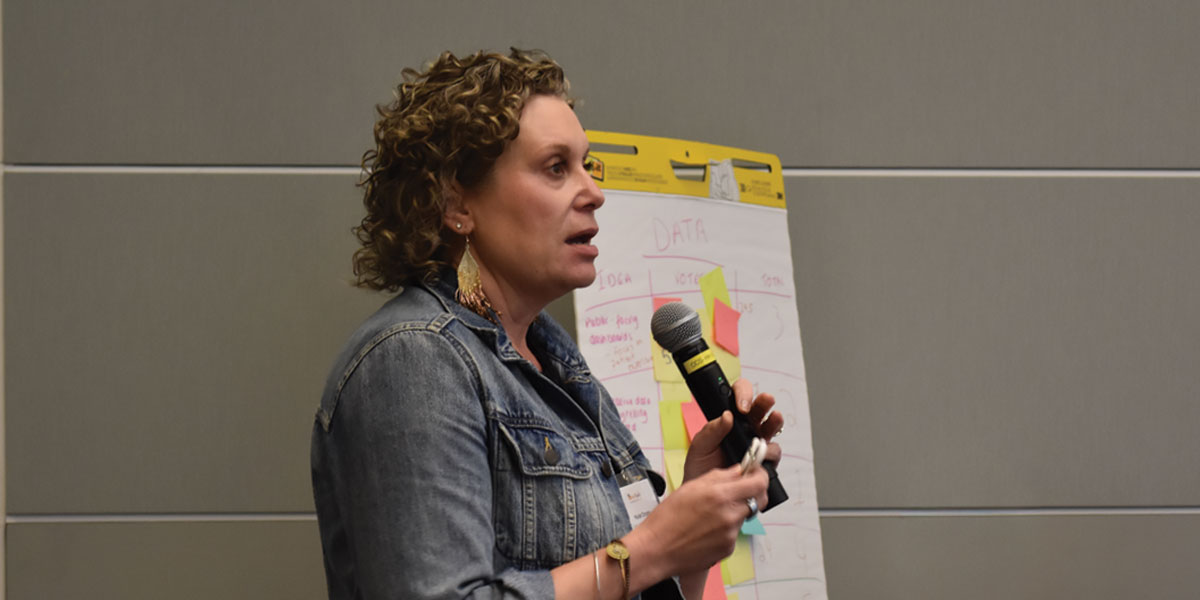
Dr. Mariah Chrans, director of operations and external affairs at the Community Health Council of WyCo, has led the initiative since its founding. She holds a Ph.D. in public health and community health, has worked in maternal child health for more than 18 years, and serves on maternal mortality review boards in both Kansas and Missouri. She frames the problem directly.
“We collectively talk about Black maternal health in a way that puts the onus on the Black body, like the level of melanin is causing the issue, which is not the case,” Dr. Chrans said. “This is happening because these systems that we put in place are harming and preventing the type of level of care that others receive.”
In its early years, Cradle KC convened providers, social care agencies, home visitors, and community members and asked them to provide a prenatal care walkthrough. The group walked through a pregnancy from the first positive test to one year postpartum. At every stage, they named what the families are asked to do, what providers are responsible for, and where things break down. That exercise revealed that not a single home visiting program participating had a policy for continuing to support a family after a pregnancy or infant loss. One group changed its policy on the spot.
Cradle KC also commissioned ethnographic research led by Jumesha Wade, Ph.D., a researcher whose work focuses on maternal and family health. Eight women shared their stories of pregnancy, labor, delivery, and postpartum recovery. The picture they painted was both urgent and deeply personal. Mothers described being pressured into C-sections they did not want, having birth wishes dismissed without discussion, rotating through providers who never learned their names, and waking from emergency surgery to learn that a stranger held their baby before they did. One mother hemorrhaged so severely after delivery that she feared she would die without her newborn ever knowing she loved him. Another described being “strong-armed” into a C-section and told afterward she was fine, while feeling anything but.
Those findings did not sit in a filing cabinet. The Cradle KC Community Action Board, a group of resident experts that intentionally excluded clinical and social work providers to protect the space, reviewed the research, pushed back where they felt the framing was off, and ensured the mothers’ voices shaped how the work moved forward. For Dr. Chrans, this is “Rooted in Justice and Joy,” in practice. Justice is hearing what Black mothers are actually experiencing and holding systems accountable for it. Joy is what those same mothers carry with them despite it.
The work has already changed how institutions operate. In the early stages of the Cradle KC Data Sharing Network, a hospital system was asked to share specific indicators on maternal and infant outcomes broken down by race. When it tried to pull that data, the hospital discovered it could not answer the question using its own electronic health record (EHR). Labor and delivery data did not communicate with the rest of the system, and the way structured data was collected made it impossible to disaggregate outcomes the way Cradle KC needed. The hospital happened to be transitioning to a new EHR and used the discovery to restructure how it collected and reported information from the ground up.
“They were able to say, we can’t even answer this question for ourselves,” Dr. Chrans said. “I never in a million years would have thought we could have impacted something like that.”
That data network is now the only community-based platform in the region linking clinical care, social care, and community health worker records into a single population health tool. Organizations contribute data that stays in their own private portal, governed by standards modeled on National Institutes of Health data-sharing policies. Anyone can submit a research project to analyze data, and the service is free.
The network collects race, ethnicity, and language data aligned with updated Office of Management and Budget standards. Without it, Black maternal outcomes disappear into broad categories like “non-white” that erase the very disparities this work exists to address. When Dr. Chrans says language, she means more than what a person speaks. She means language access: for instance, a Black deaf mother navigating pregnancy faces compounding barriers that never surface in data that only asks what language is spoken at home.
“Not only is health equity data collected in an equitable way, but that data is democratized,” Dr. Chrans said.
On the ground, the impact shows up in quieter ways. The CHC’s maternal community health workers provide wraparound support for any caregiver in the metro, from biological parents to grandparents raising grandchildren, with no income, citizenship, or residency requirement. This support is making an indelible impact.
“We hear from our community health workers all the time that my client felt like she could finally breathe,” she said. “Nobody has ever provided support to where she felt that she was an equal. That she wasn’t less than somebody else. She was seen. She was valued.”
Joy is one of Cradle KC’s four core values, alongside Hope, Action, and Data. For Dr. Chrans, it is a deliberate counter to the deficit framing that dominates social services. “I’m here because I want every single baby to make it to that first birthday,” she said. “Every single family who’s able to celebrate a child graduating high school. It’s because of joy.”
“I’ve never worked with a family who didn’t have some sense of joy or celebration and an ability to see the brighter spot, no matter what the challenge was,” Dr. Chrans said. “If a family is leading with joy, my God, you better be leading with joy too.”
When asked what one thing people could do to support Black maternal health in Kansas City, Dr. Chrans turned the question inward. “If you identify as female, how do you experience health care? When you walk in that door, what does that feel like? Do you feel heard? Do you feel respected? Do you feel safe in that space?” she said. “Once we recognize that this is an issue for everyone, we can start to see ourselves in the way other people are treated. And when that happens, our empathy changes. Our desire to see things differently and outside of our own perspective changes.”
For more information or to explore becoming a data-sharing partner, visit Cradle Kansas City.