
“Each new generation is reared by its predecessor; the latter must therefore improve in order to improve its successor. The movement is circular.” – Emile Durkheim, sociologist
The Kansas City Health Equity Learning and Action Network (the LAN), led by Health Forward Foundation, has convened the region’s health ecosystem for more than two years. This includes federally qualified health centers (FQHCs), community-based health clinics, health systems, physicians, payers, employers, community mental health centers, community-based organizations, and public health departments. The LAN includes a CEO roundtable, a learning cohort, and an action cohort.
Aligned with a set of strategic goals, and support from partners KC Health Collaborative (KCHC), and Institute for Healthcare Improvement (IHI), the LAN aims to foster anti-racism and health equity through performance and quality improvement; addressing health disparities through improved chronic disease prevention and management; increased representation of people of color in leadership roles; and increased capacity to deliver social care needs through enhanced health care delivery and payment models.
“I always say that equity is both a process and outcome,” said Health Forward CEO Qiana Thomason. “So the fact that the LAN has been able, for more than two consistent years, to convene people – many people of different roles and interdisciplinaries who continue to come and thirst for knowledge about health, equity, and racial equity, and who are practicing together is remarkable.”
Using IHI’s Community Transformation Map (CTM), a tool used to assess pre- and post-equity-centered community health improvements, the LAN charted advancements in its members’ ability to build equity capability, build quality improvement capability, and build capability to tackle adaptive challenges. “Prior to joining the LAN, members had diminished capability and capacity to understand how to engineer health equity into their systems and workplaces,” Thomason said. “And now we see significant percentage points of elevated capacity. LAN members have shared that they now have increased capacity, knowledge, and skills to practice health equity, integrate it into their systems, and engineer it within their workplaces.”
Moving from learning to action
These outcomes resulted from the learning phase that gave way to an action phase launched in the summer of 2022. Fifty organizations participated in the LAN’s robust learning cohort that focused on three areas: equity as a strategic priority, equity in community and clinical care treatment, and equity in access to social drivers of health. The action phase came next and required LAN members, who also participated in the learning phase, to participate in a competitive application process by developing concepts that focused on methodologies that identified, addressed, and developed strategies that tackle health injustices using an equity-centered, anti-racist approach. Twenty applications were submitted, and 15 of those were accepted, which included 17 organizations to accommodate cross-organizational work.
“We were thoughtful about how we curated the action teams,” Thomason said. “And of course, we looked at organizational readiness. We wanted to ensure that we had both clinical and non-clinical projects because health equity championship, especially in centering anti-racism, requires work at multiple levels – including at the policy level and at the community level.” Projects included everything from University Health’s work to address health injustices around renal functioning assessments (referred to as eGFR) using race-based clinical algorithms that are known to delay diagnosis and treatment for Black kidney patients – a national issue – to the Unified Government of Wyandotte County’s work with its health department to declare racism as a public health crisis.
“The action teams represented a microcosm of the entire health care ecosystem that have designed and implemented bold, anti-racist practices that can be measured in real time,” said Hayat Abdullahi, Health Forward’s director of community impact, who leads the Foundation’s People purpose area, and serves as a lead for the LAN. “This is everyone working together proving that policies can change, and systems can shift. You don’t even have to agree, all you need to see is the business case. That’s when it hit me that the LAN is not a program or initiative. It is a true movement.”
Motivated to stay the course
Movements tend to ebb and flow. This has been particularly true for the LAN. For some action team members, their projects aligned with their day-to-day roles and responsibilities. For others, their LAN project was an added role. “This was another thing added to their plate,” Thomason said. “So there were fits and stops just like you have with any other organizational project. But this time they were framing this work with health equity and anti-racism language which can be challenging internally. For this reason, it was integral that coaches provide support and motivation to stay the course while reminding them of the tools they had at their disposal to address resistance and regression.”
Action teams were paired with coaches who had experience with traditional models of performance and community improvement. For instance, Plan-Do-Study-Act, or PDSA, is an iterative four-stage problem-solving model used for improving a process or carrying out change, and is considered one of health care’s hallmarks for performance improvement. Among many things, the coaches’ role was to constructively challenge, support, and ask the questions that evoke thought leadership. For instance, what does PDSA look like when applied through an anti-racist lens? “So when that filter is applied, how does that change what we see, or the questions we ask of our [systems], and of ourselves?” Thomason said.
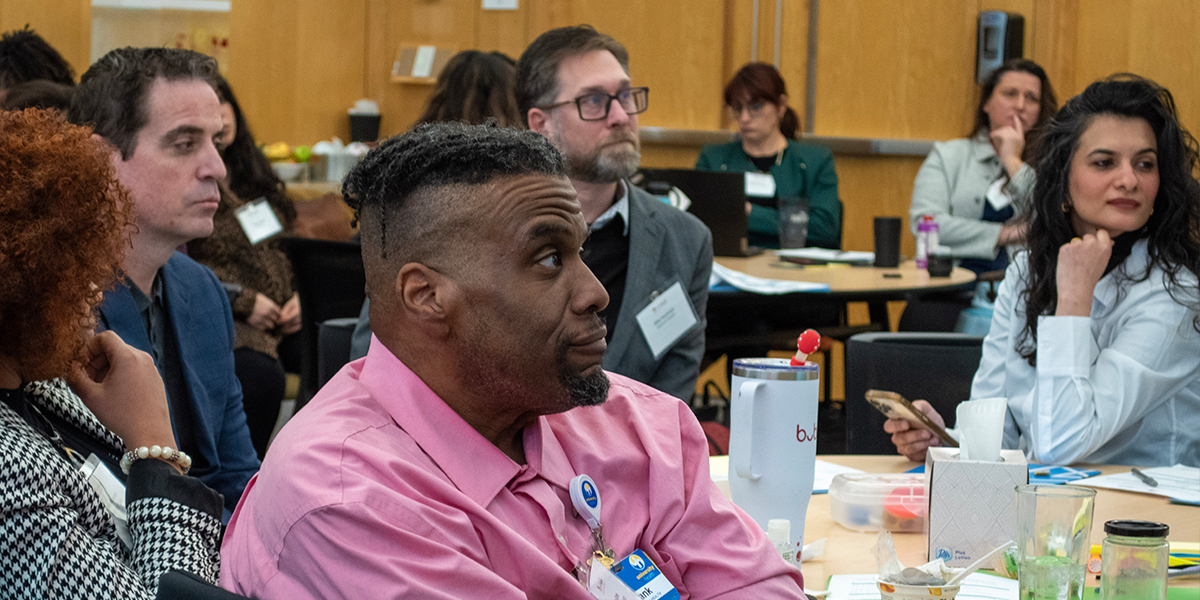
To tackle questions like this one among many others, action teams convened together. Cecilia Saffold, CEO of HealthTeamWorks, and a LAN facilitator, said they had a natural curiosity about and interest in what other teams were doing, and how they were advancing. The Community Health Improvement Leadership Academy (CHILA) allowed action teams to collaborate, cross-reference ideas, and appreciate how each project worked collectively to address biases throughout the Kansas City health ecosystem. Three CHILAs were held, each one for three consecutive days. “It wasn’t just about what we were doing – it was about finding out what others were doing and finding ways to align,” said Melissa Gard, director of operations and administration at First Call.
Saffold said the CHILAs served as a monumental evolution from the learning phase to the action phase. “It started from a mindset of very technical change and evolved to a group that was focussed on collaboration, deep sharing, peer-to-peer learning, and above all adaptive change,” she said. Action teams had a clinical or operational focus, some with mores tied to specific guidelines, standards, and practical applications learned in classroom settings. Saffold said that they leaned in with a deep commitment to listen to people with different lived experiences and centered their voices while working to drive change. “This change is sustainable and adaptive and not just technical,” she said. “And this was done in a community that is hungry to be together and to continue sharing, growing, and fostering a healthy, thriving community in Kansas City.”
“I felt everyone was in the same space together, having meaningful, important, and frank conversations,” said Naiomi Jamal, M.D. at Swope Health. “People expressed how things were really going. It is important for us to be honest about our challenges with whatever is happening, whether it’s implicit bias, racism, or other issues – and how those challenges impact the work we’re doing, and the impact we are trying to affect. It was some very real talk.”
Competing health systems collaborated during these CHILAs and agreed that the work of health and racial equity is not competitive but symbiotic. “We were very clear that what should not be competitive is equity and quality,” Thomason said. “You can’t have equity without quality. And you can’t have quality without equity. Kansas City should be a place where no matter where you go there should be the same standard of quality. This includes equity in access, treatment, and outcomes for Black and Brown people across Kansas City because of this work that we are doing right now. Now that’s a lofty goal and we’re years from that. But the work has started.”
“The seeds have been planted in every system,” Abdullahi added. “If you look at who’s part of the LAN and the action teams, you are going to see everyone that touches our communities. From health care systems to payer systems to mental health and social service organizations all coming together. There was a common denominator: we want to make it right in this region. We want to be bold enough to say enough is enough when it comes to health inequities in Black and Brown communities.”
Mobilized for what’s next
Abdullahi said it’s clear that action teams continue to dig deeper to identify and address health inequities in the communities and systems they serve. “Through this experience, we remain ever more committed to advancing equitable research practices and ensuring that every patient and family we serve is seen, valued, and supported,” said Jessi Johnson, director of equity and diversity at Children’s Mercy Research Institute.
“That’s exactly what we hoped to accomplish,” Abdullahi said. “We did not want to be the anchor for this work in perpetuity. We wanted this movement to live and stay and sustain itself within the Kansas City region’s ecosystem.”
Thomason said the LAN will continue to convene the action community, follow each project, and provide support as their equity work deepens. She said the expectation is to see consistent and sustained movement around accountability for those who hold positional power and authority. “We want to see racial equity be applied as a performance process, or that lens applied just as it is in any other quality or performance improvement process. We want to see policy change occur in Kansas City and across our bi-state area of Missouri and Kansas, and policies that protect Medicaid in Missouri, and expansion of Medicaid in Kansas. So we have to work at all levels of the LAN to be successful.”
Policy changes that support the health of perinatal women and birthing people are something else Thomason wants to see. As a result, the LAN is preparing for yet another iteration of health equity work, with its core partners KCHC and IHI, that focuses on the region’s maternal health crisis. “We are calling it LAN 2.0, which will focus on birth equity that centers improved outcomes for Black women, birthing people, and their infants,” she said.
One goal is to align the work of community-based organizations already steeped in birth equity like Uzazi Village and the Kansas Birth Equity Network, among others, and add a clinical component so that clinicians and community are working together. “We will center [belief] in that process – believing the voices of Black people and Black women, and believing they are most knowledgeable about their own bodies and experiences,” Thomason said. Another component is the use of race, ethnicity, and language (REL) data, and what Thomason calls meaningful disaggregation, to uncover differential outcomes as it relates to care, treatment, and access. “We’ll explore how to bridge the use of community with clinical systems and we’ll look specifically at blood pressure, knowing that it disproportionately affects Black women and Black birthing people. We’ll ensure that blood pressure, as a specific metric, is an area of intervention in this birth equity work.”


