In Kansas and Missouri, there is a growing movement that imagines a society without racism, and we see that racism harms everyone. We have the ingenuity to solve deeply entrenched health issues that have plagued our counties and communities for decades. We have the power to shape our reality and mold a future where people of color are free from structural racism because we know that racism, not race, drives the health inequities we see between Black and white Kansans and Missourians. That’s why it’s often said that when it comes to health care, you can’t have quality without equity – and you can’t have equity without quality.
For people of color, the COVID-19 pandemic elucidated the chasm between quality and equity. Nancy Krieger, professor of social epidemiology at Harvard T.H. Chan School of Public Health in Boston, Massachusetts, likened the virus to pulling a thread that showed “the very different conditions in which we live because of social structures that are inequitable …By pulling the thread, it is revealing patterns that have been [long known] in public health.”
As COVID devastated the nation, moves were being made to address anti-Black racism in Missouri and Kansas health systems that have sustained these long-known inequities. The Kansas City Health Equity Learning and Action Network (the LAN) was formed under the leadership of the Health Forward Foundation. Its CEO, Qiana Thomason, said philanthropy is often best situated to tackle root-cause ills. “The Foundation, with its bevy of resources, had a duty to make health equity a critical part of its purpose and mission – and instigate the necessity of change in Kansas City,” she said.
The LAN aligns with Health Forward’s purpose to support and build inclusive, powerful, and healthy communities characterized by racial equity and economically just systems. LAN partners include the KC Health Collaborative (KCHC), which brings together health care stakeholders to improve population health and health equity in the Kansas City region and the Institute for Healthcare Improvement (IHI), which spent more than two decades leveraging improvement science to advance and sustain health outcomes in health and health care globally. This triad served as the LAN’s organizing body and worked collaboratively to create high-quality health ecosystems rooted in equity, humanity, community, and antiracist practices.
More than 50 member organizations participated in the LAN, which convenes the region’s health ecosystem including federally qualified health centers (FQHCs), community-based health clinics, health systems, physicians, payers, employers, community mental health centers, community-based organizations, and public health departments.
The LAN includes a CEO roundtable, and its first cohort included both a learning and action community that provided a forum for engagement, girded by a shared agenda, with education, training, tools, and expertise to change systems, policies, and structures that perpetuate health inequity based on race and ethnicity. The ultimate goal is to create systems change in health care delivery while developing the necessary competencies and practices to realize measurable improvements steeped in equity-centered, culturally responsive health outcomes for all health care consumers.
“There is an abundance of data, national and local, that tells the story of unequal treatment for people of color, and primarily for Black Americans in our country,” Thomason said, underscoring the National Academy of Sciences’ (now the National Academy of Medicine) groundbreaking report, released more than 20 years ago, called Unequal Treatment. “It was a clarion call for the nation’s health care systems to confront racial and ethnic disparities across many domains of care, and across several different treatment types – that allow Black, Latino, and Indigenous people to fare far worse in access, treatment, outcomes, safety, and pain management.”
A System Rooted in Racism
Considering health care’s history of systemic racism, the work of the LAN is a long time coming. From the early days of Missouri’s separate but unequal segregated system of care, to the far-reaching effects of dismantling Black medical schools, the collateral damage – to this day – is more than palpable. These systems, built long ago, were designed with sheer precision and meant to be resilient.
The Flexner Report, published in 1910, is just one example. Commissioned by the Carnegie Foundation for the Advancement of Teaching, Abraham Flexner authored the Report which had far-reaching and long-standing consequences for Black doctors and Black health care consumers. Although medical racism has existed since the White Lion landed in Hampton, Virginia in 1619, the Flexner Report gave unequivocal cover and endorsement to anti-Black racism in health care.
Within a 15-year time span after the report was first published, 89 of 155 U.S. medical schools that lacked the resources to implement these new standards closed. These closures included five of the seven medical schools that trained Black physicians. This left Meharry Medical College and Howard University College of Medicine. The results of these closures are still being felt. Today, Black Americans make up nearly 14% of the population, but only 5.7% of U.S. physicians are Black. According to a 2020 JAMA Network study, an estimated 35,315 Black physicians would have flowed into the pipeline if all seven Black medical schools had remained open through 2019.
2020: The Birth of a Movement
A long, horrific history of medical racism, accentuated the pandemic, gave way to a community of people in the Kansas City region ardent for change. In 2020, plans began to unfurl for the LAN, fortified by the passage of Missouri Medicaid expansion – a ballot measure that was a signature win for Health Forward – and as communities of color endured death and destruction at alarming rates from the glaring health injustices of COVID. At the height of the pandemic, Black, Hispanic/Latino, and Indigenous people had nearly three times the mortality rate of white people.
While several factors were in play, like racism’s weathering effects referred to in the medical community as an allostatic load, or the gradual deterioration of mental and physical health, COVID had an especially insidious impact on people of color. At the same time, social injustice reverberated against the backdrop of the brutal, racially motivated murders of Breonna Taylor, Ahmaud Arbery, and George Floyd. “At that time, the community was very much jarred–and activated. So, the conditions for the LAN were right and ripe,” Thomason said.
With that she began an intricate weaving of the LAN. Thomason made calls to CEOs throughout the region and talked with grassroots leaders about their interest in the LAN. They were in. She also approached KCHC on the strength of their mission as a convening table, with a nascent yet burgeoning health equity bent. And there was also a call to IHI as their health equity model brought people together from around the globe. From Thomason’s vantage point, IHI’s model would prove more efficacious for the LAN if it assumed a place-based approach in the Kansas City region, combining the expertise and lived experiences of the community. IHI was intrigued and all in.
“The inclusion of IHI was important to have health systems, namely hospitals, come to the table and pay attention,” Thomason said. “IHI’s expertise and street credibility, along with Health Forward’s reputation and respect in the community, created a great marriage that only strengthened with the inclusion of KCHC.”
The LAN’s mission is to help community stakeholders and health systems understand the work of health equity through an antiracism lens by addressing deep, long-standing, systemic health inequities experienced by people of color. With this understanding, the design team, which consisted of [patients], caregivers, and professionals from mental health, area hospitals, public health entities, and payers, spent two years planning, organizing, and developing the framework of the LAN.
Aspects of IHI’s global health equity model were incorporated, specifically those frameworks that catered to public health and clinical settings. The LAN also intentionally coalesced the lived experiences and stories shared by people of color. These stories often illuminated inequities, including traumas from adverse clinical experiences. Among many things, it centered, humanized, and honored the voices and experiences of Black, Hispanic/Latino, and Indigenous people.
“It allowed for storytelling to happen – our own stories. We sometimes discount the lived experiences of professional people of color. It allowed me to share the story of my maternal health near-death crisis, as well as stories from so many others,” Thomason said. “You can’t jump into fixing something in a very technical way without being clear about what has occurred, what the history is, what the traumas are, and what the hopes and bright spots are in the community. And so that’s what our community added to the learning phase of the LAN. We weaved together very technical things around performance improvement, with healing and reconciliatory conversation and storytelling, and adaptive thinking.”
CEO Roundtable and Learning Community
Prior to the launch of the learning phase, the LAN engaged CEOs, many of whom represented competing health systems. “We contacted about 10 CEOs who we knew needed to be a part of the LAN,” Thomason said, “and we shared what we wanted to do. So our principal charge was and still is to connect people to their positional power and authority to address health equity,” Thomason said. This meant not allowing the buck to be passed to payers, clinicians, providers, or the state or federal government. “We recognized and acknowledged that there are multiple systems at play,” she said. “This is a structural issue that took centuries to build, and it will take a long time to deconstruct.”
The CEOs rolled up their sleeves and met for two consecutive years concurrent with the learning phase that included many of the same individuals who work with these CEOs at their organizations and in their health systems. They continue to convene around this work today.
Although more rigorous than the CEO roundtable, the learning community was focused on three areas: equity as a strategic priority, equity in community and clinical care treatment, and equity in access to social drivers of health. IHI’s global health equity initiative was also instrumental in helping the LAN create a community transformation map used to measure change, and pre- and post-intervention of the work that manifested from both the learning and action phases of the LAN.
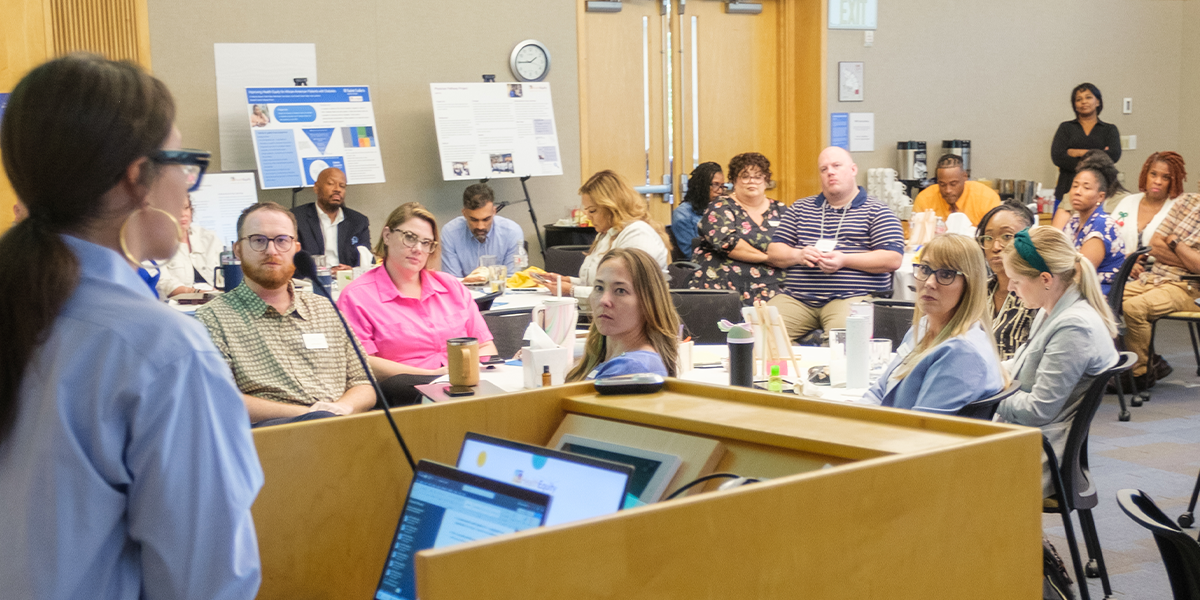
Health Forward, IHI, and a local group of players that made up the area’s health ecosystem — including grassroots organizations and health care consumers — developed the learning curriculum. In February of 2022, the learning community officially launched. Because of the pandemic, the first session was an online event held via Zoom. Cecilia Saffold, CEO of HealthTeamWorks, and a LAN facilitator, was on the call. She said for her, the LAN started as a hopeful curiosity and an opportunity to be in community with others as they embarked on a shared learning experience.
“I had a nervous excitement,” Saffold said. “There were folks you hadn’t seen in months and, in some cases, years, and new faces as well. They represented the entire health ecosystem -– public health, health systems, community-based organizations, FQHCs…Nowhere in Kansas City did you have all of those entities and organizations represented to talk about the state of health of our communities. Nowhere.”
Saffold said even with hopeful excitement, there was complete uncertainty about what the LAN is, and where it would take them. “But it came with structure, community, tools, resources, and information,” she said. Shared definitions were an inaugural tool of the learning community. Saffold said in order to have a shared understanding that the LAN and its community were moving the same needle, it was vital to have a shared set of definitions that offered a common starting point. She added that a simple Google search of the words health equity would yield varying definitions, all with key differences.
“We can all work in different parts of this ecosystem and know that we are moving towards the same goal because we defined what it means to achieve health equity,” Saffold said. However, learning the language did come with challenges. Words like anti-Black racism, white supremacy culture, white dominant culture, systemic racism, and structural racism, among many others, came with a sting at times and caused tension at the earlier stages of the learning phase.
“I define tension as the strain that’s needed for growth,” she said. “The tension was necessary because without discomfort you can’t change, you can’t shift.” Saffold said the shared language and definitions made some people start from a place where they felt deeply accused, pointed out, and shamed. Some felt discussions about privilege and power meant they were individually racist and prejudiced, and the cause of anti-Black racism in health care settings.
Some whose lived experience included abject poverty with minimal financial resources and social support felt particularly called out by discussions of white privilege and were resistant to align that definition with themselves. Breaking through meant deconstructing what Saffold calls empowered fragility. “Hearing stories, hearing experiences, hearing outcomes that resulted from systems that are designed to benefit one group to the detriment of another group provoked an immediate response that these same systems are detrimental to me, too,” she said. “And it’s not saying that nothing negative has happened to you. It’s not saying that you’ve not had egregious experiences or poor experiences. But the LAN’s focus is the inability for individuals to receive equitable access and delivery of care because of race, ethnicity, religious background, national origin, and other factors — elements that are completely out of one’s control.”
Thomason said the LAN’s organizing team has always been and continues to be intentional around the learning community’s development. The shared definitions, along with a call to antiracist practices, ways of thinking, and acting can be intellectually jarring and emotionally challenging, she said. For this reason the learning community had access to licensed clinicians during every session that they could speak with confidentially while they processed, reflected, and expressed whatever emotion they felt in that moment.
“We were exposing a reality that some people never conceived even existed,” Thomason said. To help, the learning community curated a set of “guideposts” that set the tone for courage and vulnerability to navigate tensions and eventually see beyond personal lived experiences. One was, “uncomfortable doesn’t mean unsafe. Doing the work of health equity comfortably is not possible,” Thomason said.
Another guidepost was calling people in, not out. Instead of making people feel called out for their belief systems or mindsets, it was an invitation to lean into the learning process, and into a natural curiosity and exploratory way of thinking about health equity work, even while experiencing a sense of vulnerability. The learning community was also asked to hold tension in “life-giving” ways. Thomason said this meant not allowing the tension to shut down the conversation or preclude something from being discussed. This was especially important because the work required respecting the different vantage points and resolving to explore the tensions in the room and in the moment.
Committing to non-closure was yet another guidepost. “You can’t open people’s minds and hearts in a room to talk about things like health equity, inequity, racism, antiracism, bias, and think that every learning segment will end with this nice pretty bow,” Thomason said. “It doesn’t work that way. Committing to non-closure allows individuals to stay in the space of having to do their own work outside of the room because that’s where the real work happens.”
Additionally, the Race Equity Institute’s (REIs) Groundwater training, a metaphor designed to help practitioners at all levels internalize the reality that we all live in a racially-structured society, was integral in shifting perspectives from individualized shortcomings to a wider, deeper, systemic issue. Saffold recalls that REI explained it like this: If you are walking and you see one dead fish that’s floating on top of the lake, you can say it’s simply a dead fish. But if you come back the next day and there are hundreds of dead fish it’s less likely to assume that all of these dead fish reached the end of their lifespan in a day. Instead, the more likely assumption is there’s something in the water or in the environment that’s causing the demise of hundreds of fish.
“If you look at examples of inequities in our education, in our criminal justice system, in health care, in housing, in transportation across the country and in every community that you sample, you can find inequity, after inequity, after inequity when it comes to outcomes for individuals who are Black and Brown,” Saffold said. “This is when you stop asking what’s wrong with this person and start asking what’s wrong with the system in which these people are functioning and trying to survive?”
Saffold added that the Groundwater approach and others like it are instrumental in demonstrating that health inequity is not about individual racism, but about systemic racism that was structurally assembled to favor one group at the expense of others. “Systemic inequities are built into how these major institutions function that we interact with every day,” she said. “And that’s the focus of the LAN. I think this messaging was hugely impactful during the learning phase.”
Thomason added that adequate time was given to really unpack the language. “We’re not talking about people in white hoods,” she said, “we’re talking about [systems] and structures that make whiteness the dominant way of being and the dominant way of thinking. We helped the LAN community understand what structural racism meant and through decisions, policies, and practices that antiracism in health care settings could be achieved through our collective action.”
Saffold said through the work of the learning community, the LAN was able to evolve mindsets to a place where individuals were no longer centering their own gut reaction to certain terms. “They weren’t internalizing the call for a need to change systems of practice in health care,” she said. “Instead, they were identifying their own ability to address their implicit biases and to consistently commit to delivering high-quality, equitable care, along with ways they could impact systems – because that’s where their privilege came in.”
Hayat Abdullahi, Health Forward’s director of community impact, who leads the Foundation’s People purpose area, as well as serves as a lead for the LAN, said when she attended the LAN’s first Community Health Improvement Leadership Academy (CHILA), the weight of it all landed hard. “The LAN is a microcosm of the entire health care ecosystem where we can design bold, antiracist practices, implement these practices, and then measure what happens in real time,” she said. “That’s when it hit me. The LAN is not a program or initiative. It’s a movement.”
Saffold added that the evolution of the learning phase was evident by the learning community’s understanding that the work of addressing anti-Black racism was systemic as opposed to an individual indictment. “It was a call to action to leverage the resources and the power they had and extend that privilege to the patients and communities they serve.”
Another key impact of the learning phase was the community it built. “What I love about the learning community era of the work is that the goal was to develop a common understanding of the problem and inspire uncommon courage and uncommon resolve for action,” Thomason said. “And that’s essentially what the learning community did. It was a rich time of learning and being together that increased the appetite of those learners from 52 organizations to say, ‘We can’t just stop here. We have to do more.’ And that more starts with more questions, more learning, more introspection, and more curiosity about our own internal systems within our own organizations. And with that, the action community was birthed.”
Part Two will cover the LAN’s action phase, its players, the work they’ve undertaken, and how they’ve fared thus far. It will also showcase data-driven outcomes that depict advances around health and racial equity among the LAN community.