
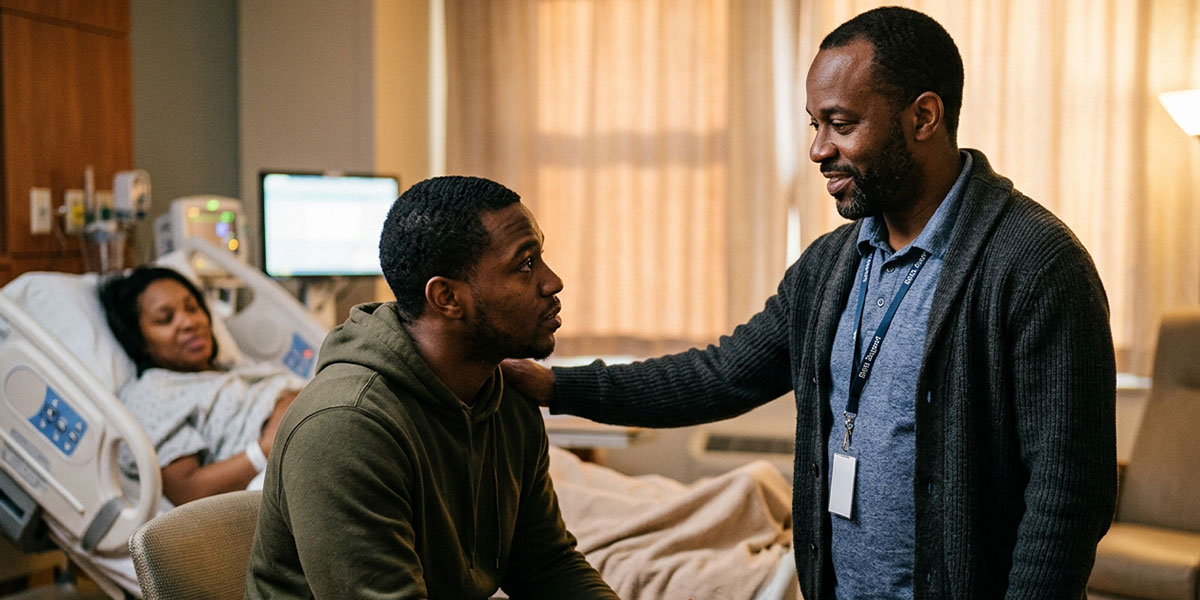
When James Hogue and his wife, Shunquita, learned they were expecting their first child, they did what many first-time parents do. They researched everything. They found a midwife, built a birth plan, and committed to a natural home birth in their Kansas City home. Then, roughly six to eight weeks before her due date, Shunquita developed gestational diabetes and preeclampsia, a dangerous form of high blood pressure that the Preeclampsia Foundation estimates is 60% more common in Black women than in white women. The home birth was off the table, and the couple found themselves navigating a hospital delivery they had never planned for.
What happened next is what changed the trajectory of Hogue’s life. Armed with the education he and Shunquita had received from their doula, he stepped into the role of defender in real time, pushing back against interventions the couple had not consented to and making sure his wife’s concerns were heard by the medical staff attending to her.
“There were often times where I had to have literal back-and-forths with the medical staff because of some of the interventions that they were presenting,” Hogue told KCTV5.
When Shunquita was asked how it felt to have her husband speak on her behalf at that moment, she answered with a single word: “Safe.”
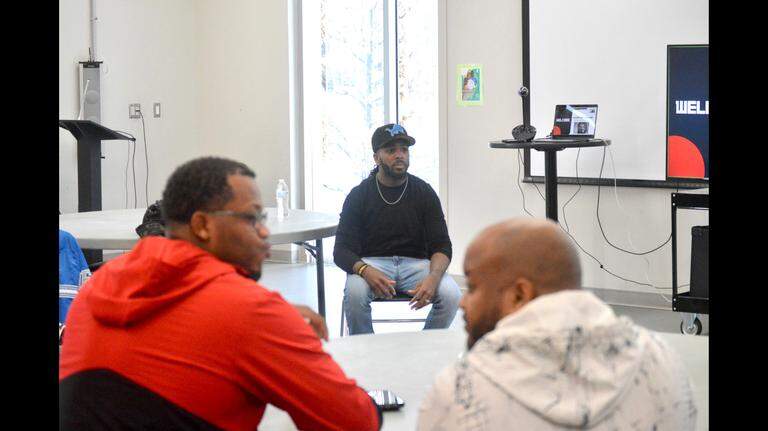
James Hogue, founder of nonprofit Fathers Assisting Mothers, teaches expecting fathers and non-birthing partners on how to become active participants in the childbirth experience. His program offers in-person lectures and self-paced courses online. (Photo source: James Hogue; Kansas City Star)
That experience became the origin story of something much larger. Hogue trained and certified as a birth doula, then founded Fathers Assisting Mothers, known as FAM. But Hogue is not showing up to anyone’s delivery. His mission is to take what he learned through doula training and pour it directly into other expectant fathers so they can fully show up for their own families.
FAM’s flagship offering is the Dad Doula Bootcamp, a free, four-week program designed to walk expectant fathers through the full arc of the birth experience. The first week covers what Hogue calls “Fatherhood 101,” an introduction to how life changes across the stages of pregnancy. Week two gets into the specifics of labor and delivery, including medical terminology and an overview of common interventions, so fathers understand what is happening and what questions to ask. The final two weeks focus on building a care team and learning how to speak up effectively for the birthing mother in a clinical setting. FAM also runs DadPrep Academy, a specialized 12-week program designed to equip teen fathers with the tools to navigate early parenthood.
The education Hogue passes along is rooted in the same curriculum that professional doulas complete. Doula certification through organizations like DONA International typically requires a 16- to 24-hour approved workshop covering the anatomy and physiology of pregnancy, the stages of labor, pain management techniques, common medical interventions and their implications, communication skills, and lactation support. That body of knowledge is what allowed Hogue to recognize what was happening when his wife’s birth plan fell apart and to push back when the medical team proposed interventions the couple had not discussed. It is also what he believes most partners are never given the chance to learn.
Hogue credits his lifelong friend, Brandie Bishop-Stacker, of the National Black Doulas Association, with providing the foundation for his training. “He was so passionate about his wife being protected and cared for during her pregnancy and to her postpartum,” Bishop-Stacker told People. “He really went headfirst into really getting information and wants others to have that, too.”
That last point is critical. Less than 6% of certified doulas in the United States are men, and only 9.4% are Black, according to workforce data collected by Zippia. Hogue, a former teacher and school principal, is working to change both of those numbers at once. The program is not a replacement for a professional doula. It is, in Hogue’s framing, a way to ensure that the partner in the room is not a bystander but an informed, prepared participant in one of the most consequential moments a family will face.
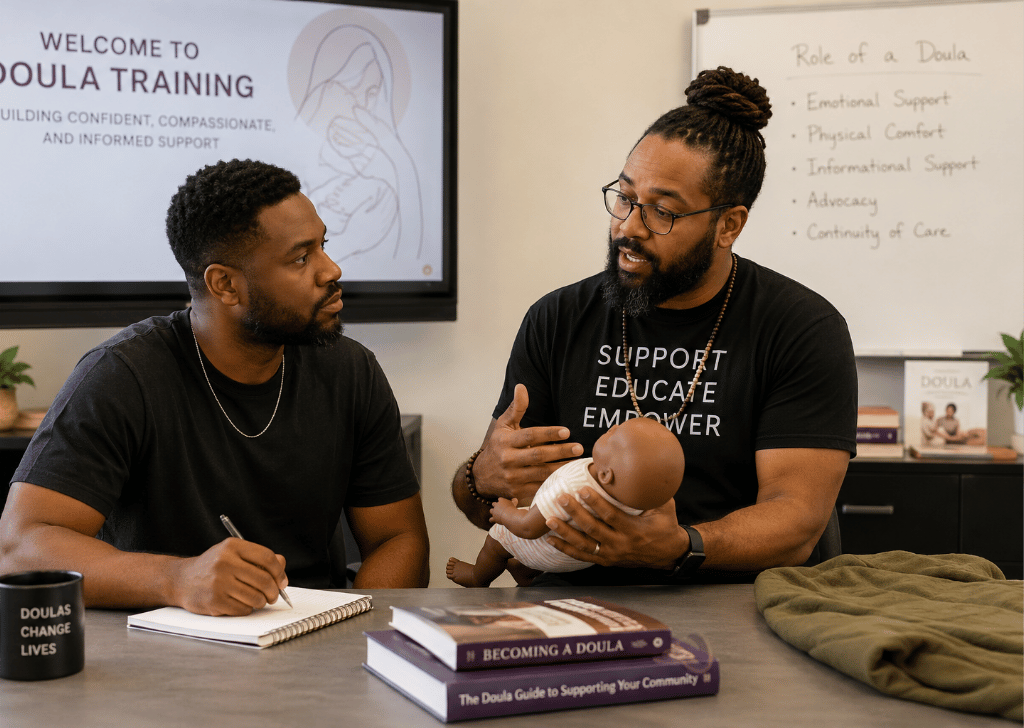
That last point is critical. Less than 6% of certified doulas in the United States are men, and only 9.4% are Black, according to workforce data collected by Zippia. (Photo source: AI-generated on Canva)
A growing roster
Hogue is part of a broader wave. In St. Louis, the organization Dear Fathers runs Dads to Doulas, a six-week virtual cohort designed specifically for Black men that covers reproductive health history, systemic contributors to maternal mortality, and hands-on preparation for pregnancy, labor, and the postpartum period. Participants who complete the training can pursue formal doula certification, and the program has drawn national attention through features on “The Jennifer Hudson Show” and NBC News. In Sacramento, Daddy Doulas uses sports-inflected language to meet expecting partners where they are, organizing its offerings around a “game plan,” a “playbook club,” and “huddle ups.” And Melanated Daddy’s Dad Doula University offers a self-paced parenting course featuring interactive activities, fatherhood panels, and a workbook to support the transition into parenthood.
What connects these efforts is a shared recognition that the traditional model of birth support has largely left one person in the room without a playbook. The doula attends to the birthing mother. The medical team manages the clinical picture. And the partner stands to the side. “We find that men are often sidelined in the process,” said Hakima Payne, CEO of Uzazi Village, which partnered with Hogue to bring fathers into the maternal health conversation. “They’re not readily included, and we wanted to change that dynamic.”
Why this matters now
The urgency behind these programs is not abstract. The Centers for Disease Control and Prevention reported that the maternal mortality rate for Black women remains more than three times the rate for white women, with no statistically significant improvement year over year. In Missouri, the picture is especially grim: Black women are three times more likely to die within a year of pregnancy than white women, women on Medicaid face seven times the mortality risk of those with private insurance, and 80% of the roughly 70 maternal deaths that occur in the state each year were deemed preventable. “That means if a father is trained and aware of what’s happening and knows how to advocate, we can reduce some of these disparities,” Hogue told People.
At the same time, research continues to build the case that doula support produces measurable improvements in birth outcomes. A scoping review published in npj Women’s Health synthesized 23 studies and concluded that doula support was associated with reduced cesarean rates, fewer preterm births, shorter labor duration, and higher rates of breastfeeding initiation. A separate study in the American Journal of Obstetrics and Gynecology showed that for every 100 patients who received doula care, there was a significant increase in vaginal births after cesarean and in postpartum follow-up visits. And a recent review of clinical trials published in JAMA Network Open linked doula support most consistently to lower maternal anxiety, higher breastfeeding initiation, and better postpartum follow-up care.
The policy landscape has been shifting to match. More than half of all states now provide Medicaid reimbursement for doula services, according to the National Academy for State Health Policy, up from just two before 2020. Missouri began reimbursing doula services through MO HealthNet after the Department of Social Services issued an emergency rule citing “an immediate danger to the public health, safety, or welfare of pregnant women in Missouri,” and the Missouri House passed HB 2372 in April 2026, which would expand coverage from six to 16 visits, though the bill still awaits legislative hurdles before becoming law. Doula care is classified as an optional service under Medicaid, meaning proposed federal spending cuts that could reduce Missouri’s Medicaid funding by billions over the next decade, the long-term stability of that coverage survives.
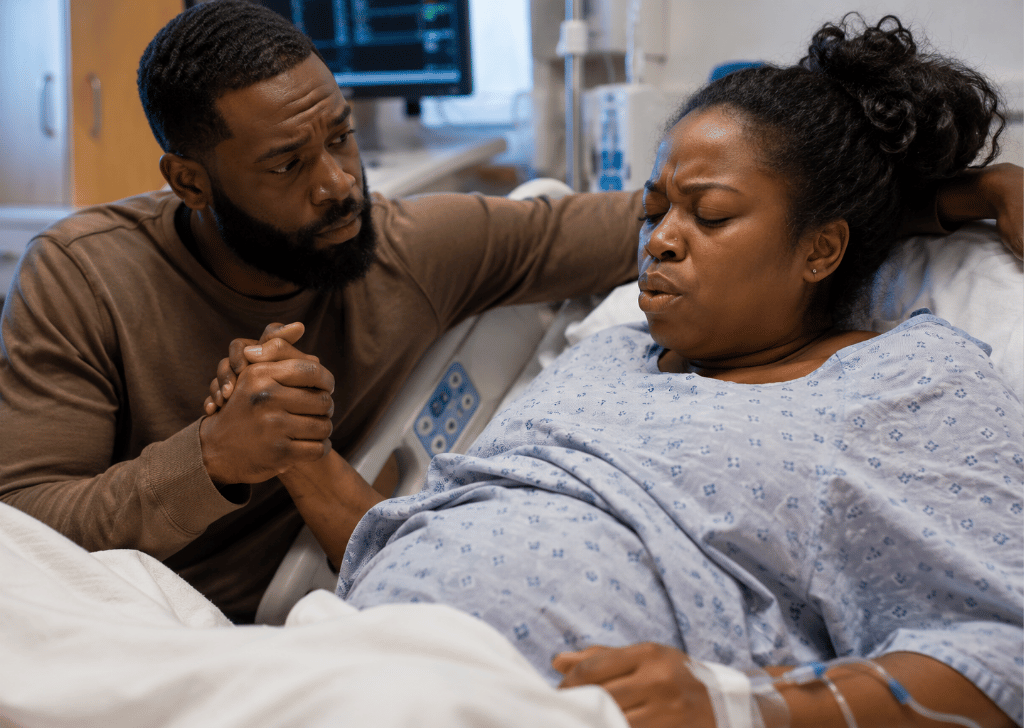
When a partner understands the warning signs of preeclampsia, knows the difference between elective and medically necessary interventions, and feels empowered to speak up when something does not feel right, the entire dynamic in the delivery room shifts. (Photo source: Canva AI)
The partner as first line of defense
None of these policy changes, however, specifically addresses the role of the partner. Medicaid reimburses doula care for the birthing mother. The clinical team is focused on the mother and baby. And while community-based doulas have proven their value, their availability remains limited, particularly in communities of color and in rural areas where the workforce is thin.
That access question is playing out in real time across Kansas City’s maternal health landscape. Uzazi Village, the nonprofit where Hogue mentors fathers, recently announced it will begin charging a fee for some services after losing state funding, while organizations like Altruism, Inc. continue to provide free doula and community health worker support through The Maternal and Infant Health (MaIH) Center. The shifting patchwork of who can offer what, and at what cost, only reinforces why equipping partners with their own knowledge matters.
This is the gap that programs like Hogue’s are designed to fill, from an entirely different angle. They operate on a simple premise: the partner will almost always be in the room, and if that person is educated and prepared, they become an additional layer of support that no policy can mandate and no insurance plan can bill for.
Hogue has not built his work alone. His partnership with Payne and Uzazi Village grew from a shared conviction that fathers belong at the center of the birth experience, not on its margins.
The collaboration reflects a broader understanding within maternal health work that reducing mortality and morbidity requires engaging the full ecosystem around a pregnant person, not just the clinical providers and not just the mother herself. When a partner understands the warning signs of preeclampsia, knows the difference between elective and medically necessary interventions, and feels empowered to speak up when something does not feel right, the entire dynamic in the delivery room shifts.
For Hogue, the measure of success is not whether fathers keep coming back. It is whether they no longer need to.
“Those are the experiences that we truly enjoy, when we aren’t needed,” Hogue said. “When someone else is able to walk through it and then come back and pour into others. That’s amazing for us.”
The daddy doula movement, if it can be called that, is still small. It does not have the institutional backing or the insurance infrastructure that traditional doula care is beginning to build. But it is growing in the spaces where the need is greatest, in cities like Kansas City and St. Louis, where the data is damning, and the stakes for Black families remain disproportionately high. And it is being built, in almost every case, by fathers who went through something difficult, learned from it, and decided that no one else should have to walk into a delivery room unprepared.


