On a Monday morning at Uzazi Village, a pregnant woman sits in a circle with other expectant mothers. She has already seen a nurse practitioner and a midwife. A plant-based chef is preparing a meal for her. Her doula helps her work through a birth plan. If she needs therapy, chiropractic care, or lactation support, it is down the hall. If she needs diapers, baby clothes, or groceries, those are here too. Her appointment will last about two hours, and it will not cost her anything.
This is what prenatal care looks like when it is built by and for Black families. For 13 years, Uzazi Village has operated from a building on historic Troost Avenue in Kansas City, offering a model of maternal and infant care in a community where the need has only grown more urgent. Jackson County received an F from the March of Dimes for preterm births. When Research Medical Center closed its labor and delivery unit and NICU in September 2025, it removed one of the few remaining delivery options near Uzazi’s front door. Nearly 42% of Missouri’s counties are classified as maternity care deserts.
As Black Maternal Health Week 2026 marks a decade of national advocacy under the theme “Rooted in Justice and Joy,” Uzazi Village is both proof that something different is possible and a reminder of how much work remains.
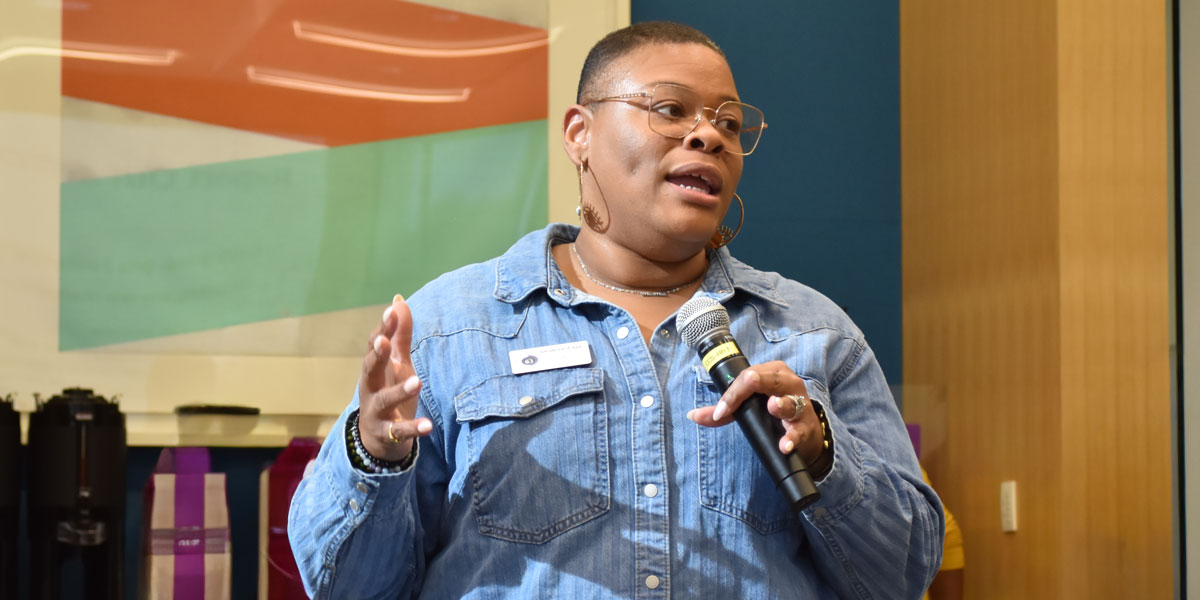
“Uzazi has always done reproductive justice work. That’s why we’re here,” said Shalese Clay, president and CEO of Uzazi Village. “But this year, we’ve been reminded that the joy piece is missing from a lot of our stories. Even through the storm, there is always some array of sunshine.”

Participants are not cycling through departments or chasing referrals across town. Clinical care, mental health, nutrition, lactation, doula support, chiropractic services, and community resources all live under one roof. (Photo by Mikhail Nilov.
A Village, Not a Waiting Room
The Ida Mae Patterson Center for Maternal and Infant Wellness is built on the Village Circle Approach, a group prenatal care model rooted in Afrocentric principles, in which pregnant participants move through care in peer cohorts, receiving education, clinical support, and community in a culturally validating environment.
What sets it apart is the depth. Participants are not cycling through departments or chasing referrals across town. Clinical care, mental health, nutrition, lactation, doula support, chiropractic services, and community resources all live under one roof. The organization also operates a clothing boutique, and its diaper program is in partnership with HappyBottoms. On Wednesdays and Fridays, families can take home food. No insurance, documents, or referral required.
“You come into your auntie’s house, you smell the food, you get loved on, we hold your babies,” Clay said. “We want them to feel like they are in a family.”
Uzazi is also expanding beyond pregnancy. Community Care Days, launched on the second and fourth Fridays of every month through a partnership with Healthy Blue, offer breast exams, HPV testing, well-woman visits, Pap smears, and STI testing for uninsured women. A direct primary care practice and family medicine provider are being added to serve partners and family members.
“Now we want to make sure the partners are supported in their health care journey too,” Clay said. “Whether that’s mental health, chiropractic, or general wellness.”

As Black Maternal Health Week 2026 marks a decade of national advocacy under the theme “Rooted in Justice and Joy,” Uzazi Village is both proof that something different is possible and a reminder of how much work remains. (Photo by William Fortunato.)
Filling Gaps the System Cannot See
Food insecurity has become one of the most visible needs Uzazi’s families carry through the door. What began as a small fresh produce offering through After the Harvest, a local food rescue organization, grew into a full distribution effort after Uzazi partnered with NourishKC. When federal SNAP benefits were cut, the lines grew longer.
“When I tell you, we get a line of people out the door waiting for us to start,” Clay said. “That part was concerning, yet I’m grateful that we’re able to provide support.”
Clay sees food access, poverty, and environmental conditions as inseparable from maternal health. Many of the families Uzazi serves live in food deserts and rely on public transit. “It’s not just the health care system,” she said. “Poverty has driven a lot of why things and practices are happening the way they are.”
Uzazi’s home visiting program has proven to be another critical safety net. Clay described a recent case in which a registered nurse conducting a postpartum visit noticed something was wrong with a new mother. The nurse contacted Uzazi’s nurse practitioner, and they got the mother to the hospital immediately. She had developed postpartum preeclampsia and fluid on her lungs. Hospital staff initially dismissed her symptoms, telling her she was simply tired from having a baby.
“If it wasn’t for our team being there, that mom could have lost her life,” Clay said. “And the hospital didn’t believe her.”
Missouri ranks 44th in the nation for maternal health outcomes. Black women in the state face a pregnancy-related mortality ratio of 72 deaths per 100,000 live births, nearly three times the rate for white women, according to the Missouri Department of Health and Senior Services. More than 70% of those deaths were deemed preventable. For Clay, these numbers reflect not just a health care failure but a historical one.
Clay pointed to research from Sharla Smith, Ph.D., a maternal health researcher at the University of Kansas School of Medicine, showing that Black maternal and infant mortality rates today are worse than they were before the end of slavery. For Clay, the reasons are rooted in what was lost. “We were birthing our own babies. Midwives came about because there weren’t doctors coming to the slave quarters,” she said. “This is historically how we took care of our community.”
Uzazi Village was founded in that tradition. In 2012, Hakima Tafunzi Payne, a labor and delivery nurse who witnessed systemic racism in hospital birthing rooms, joined with co-founders Mariah Chrans, Rebecca Liberty, and Tash Reed to build a space grounded in the legacy of Black birth work. Payne also created Chocolate Milk Café, a breastfeeding support program for Black families that has grown to serve communities nationally. The organization’s doula training has certified birth workers in nine states.
But training doulas is only part of the equation. Sustaining them is the deeper fight. Clay, who stepped into the CEO role in November 2024, sees the tension clearly. Many doulas are independent contractors juggling multiple jobs while waiting 60 to 90 days for Medicaid reimbursement. Potential funders cite a lack of oversight as a reason not to invest, even as the demand for doula care grows. At the same time, doulas and midwives are facing increased pushback in clinical settings, from being forced out of hospital rooms to having their role questioned by the very systems their clients need them to navigate. Uzazi is revamping its doula curriculum to build more structure, create policies that demonstrate the value of the work, and strengthen buy-in from health care systems.
“The doulas need a doula,” Clay said. “A lot of them are doing heart work. We need to do better at protecting and paying the people who are doing the work that was only needed because the system failed us.”
Looking ahead, Clay’s vision for Uzazi includes postpartum houses, satellite clinics, and an expanded training program. She is hopeful. A recent birth equity trip to Montgomery, Alabama, organized by the Health Forward Foundation, shifted something for Clay, who said she saw hospital and clinic leaders engaging with Black and Brown maternal care in ways she had not seen before. “Typically, being a Black woman working in a white male society, you’re not always welcome to the table,” Clay said. “But I do feel like we have a lot of people who are leading hospitals and clinics who are now understanding the importance of this work.”
“We cannot do this work in silos,” Clay said. “We have to work together. Whether that is big health care centers or other community-led organizations, we have to figure out how to share resources.”
When asked what real change for Black maternal health would look like, Clay’s answer was simple.
“When we are no longer needed,” she said. “That’s when real change happened.”
For families in Kansas City who want to connect with Uzazi Village, all services are available at 4232 Troost Avenue. No insurance, documents, or referral required.