On any given month in Kansas, a pregnant woman in a rural community logs into a virtual prenatal care group led by a doula. Across the Kansas City metro, fathers sit in a barbershop talking about their mental health over dinner. In a Kansas City, Kansas, neighborhood, a mother walks to a depot to pick up diapers, food, and toiletries. At the University of Kansas Medical Center, a medical student learns what equitable care actually looks like from the community she will one day serve. All of it connects back to one network.
Sharla Smith, Ph.D., MPH, an associate professor in the University of Kansas School of Medicine’s Department of Population Health, founded the Kansas Birth Equity Network (KBEN) in 2021 because the people doing the maternal health work in Kansas, the doulas, the midwives, the researchers, the parents, were all working in silos. The resources existed. Families just could not find them, and the systems meant to protect pregnant people were failing Black women.
Supported by a Eugene Washington PCORI Engagement Award, KBEN started with 34 stakeholders. Today, it has more than 190 across Kansas and the Kansas City metro area, convening parents, doulas, midwives, physicians, researchers, faith-based organizations, and community advocates around a shared commitment to improving maternal, paternal, and infant health for Black families. It does that not by replacing what already exists, but by connecting it, strengthening it, and making sure families know it is there.
For Dr. Smith, that work reflects the heart of Black Maternal Health Week, which marks its 10th year in 2026 under the theme “Rooted in Justice and Joy.” The week highlights not only the challenges Black mothers face, but also the people, programs, and partnerships working to improve care and support.
“In order to have justice, you must have the knowledge about what is available to you,” Dr. Smith said in a recent interview with accessHealth News.
KBEN puts that principle into practice twice a year through community events that bring together nearly 30 organizations and service providers in one room, from banks to diaper suppliers to licensed day care providers. Alongside parent discussions, meals, and board-donated giveaways, the events are designed to help families access the practical support they need in one place. For families navigating communities where clinics have closed and labor and delivery units have shut down, one afternoon with the right information and right connections can change the trajectory of a pregnancy.
But the events are just the front door. Behind them is the Network’s year-round work.
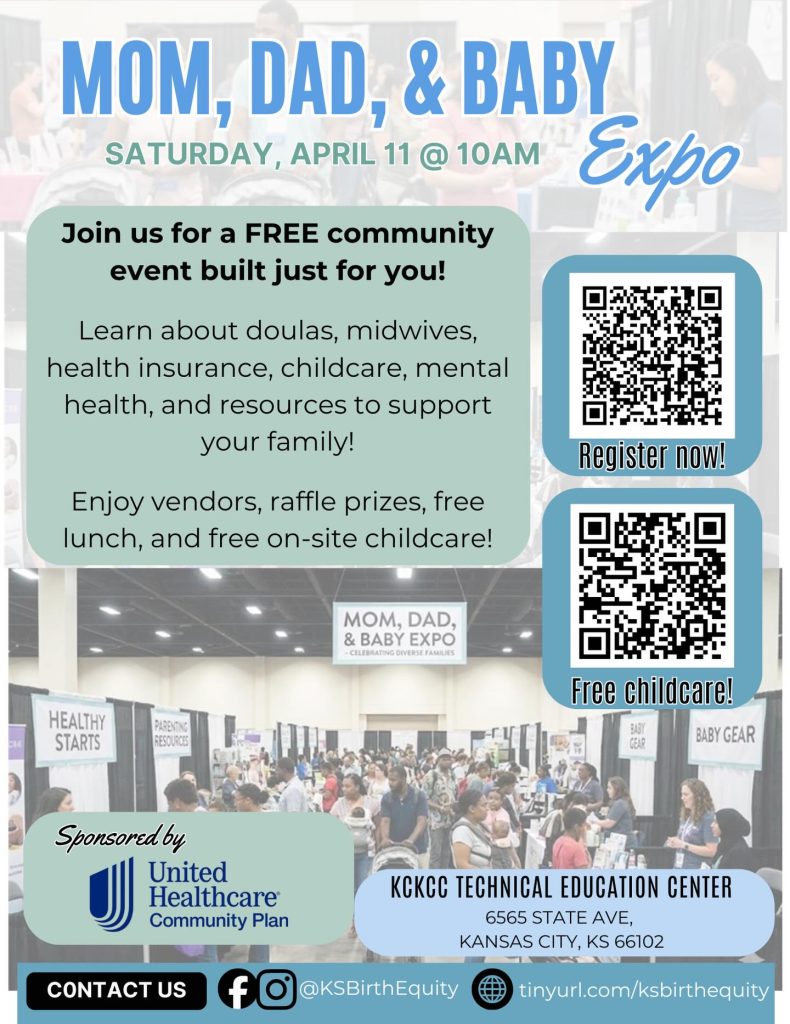
Mom, Dad, and Baby Expo 💙 a free community event centered on community, conversation, and connection to resources!
How the Kansas Birth Equity Network reaches families year-round
In a Kansas City, Kansas neighborhood with some of the highest maternal morbidity rates for Black women in the area, KBEN runs a diaper depot that provides 75 diapers per month to families, along with food and toiletry donations. The depot doubles as a bridge, connecting parents to research opportunities at the university and inviting them to help design the studies themselves.
The Network’s group prenatal care program is doula-led and fully virtual, centered on reducing hypertensive disorders in pregnancy, including early-onset preeclampsia. Over six weeks, participants receive Bluetooth blood pressure monitors, an Apple Watch through an Apple grant, and a virtual doula who provides support through birth. Families across Kansas and the Kansas City metro can participate.
Fathers have a seat at the table, too. KBEN’s barbershop initiative, Fathers Matter Too, meets monthly and pairs a mental health professional and a dad doula with fathers for honest conversations about paternal mental health. They meet in a barbershop, share a meal, and talk about what it takes to support a mother and child while also caring for themselves.
On the clinical side, Dr. Smith developed a Birth Equity Clinical Scholars program within the KU School of Medicine that trains OB-GYN and family medicine residents to provide equitable care. Those residents work alongside Uzazi Village, which serves Black pregnant persons in the Kansas City metro, and learn about maternal health policy through an advocacy component that includes Capitol visits. A free birth equity curriculum developed through KBEN is now being used with medical students, residents, and nurses statewide, helping build a broader foundation for respectful maternal care.
What Black families in Kansas are still navigating
Still, Dr. Smith said families are navigating a range of barriers that can make pregnancy and postpartum care harder to manage, including delayed responses from providers, fragmented referrals, canceled prenatal appointments with little guidance about next steps, rising housing costs that force parents into shared living situations while working two jobs, and a shortage of mental health services in the communities that need them most.
Dr. Smith said KBEN hears both encouraging and troubling stories from families. Some describe strong support from providers and social services, while others describe being dismissed, shuffled between systems, or left without clear follow-up. “Parents are not being listened to,” Dr. Smith said. “They are the experts of their own body, and a lot of times what they share is not taken seriously.”
KBEN’s growth reflects more than momentum. It points to what becomes possible when Black families, birth workers, clinicians, and researchers are connected through a shared purpose. Meeting attendance has climbed from 30 to 83 participants. A $50,000 grant funded more than 17 community-based birth equity projects across Kansas and Kansas City, Missouri. KBEN also played a direct role on a Kansas task force that developed a plan to reimburse doulas through Medicaid, a policy change that could reach families who would never have been able to afford that support on their own.
Kansas is also in the first year of a 10-year federal Transforming Maternal Health program for Medicaid-covered mothers. KBEN wrote a letter of support during the grant-writing process and is now working to ensure the initiative reaches Black families in rural communities where relevant, culturally appropriate resources are hardest to find.
When asked what it will take to sustain this work, Dr. Smith was direct: funding, state investment, policymakers who consider how every policy affects families, and representation in clinical settings that reflects the communities they serve.
“Black families are not the reason for these outcomes,” Dr. Smith said. “Focus on the systems.”
At its core, KBEN is working to make sure families do not have to navigate pregnancy, birth, and postpartum support on their own.
For families looking to connect, visit k-ben.org or reach out at kben@kumc.edu. The Network also maintains a community resource booklet for parents seeking support and services.
“Get active,” Dr. Smith said. “Even if it’s not 100%, please get active. So you have the support and the village you need during pregnancy and postpartum.”